
Exploring Moroccan Architecture: A Journey Through History, Culture & Craftsmanship
Exploring architecture is one of the most rewarding ways to understand a country's history. Every archway, carved cedar panel, and hand-cut mosaic tile reflects past civilizations, trade routes, and spiritual traditions.
If you are looking to dive deeper into Moroccan culture, visiting its architectural landmarks is an absolute must. They offer profound insight into Morocco's artistic heritage and the deep ties between art, history, and daily life.

Traditional mosque architecture harmonizing with the natural desert landscapes of Morocco.
The Trace of Historic Influences
Morocco's strategic location at the crossroads of Africa, Europe, and the Middle East allowed it to absorb architectural influences from multiple world civilizations.
Over the centuries, Roman settlements, Arab-Islamic dynasties, Spanish-Moresque refugees, and later French urbanization brought distinct design characteristics to the country.
Furthermore, centuries of trade routes across the Sahara Desert integrated African tribal traditions from south of the desert, creating a uniquely diverse architectural style found nowhere else in the world.
Berber Influences: Earthen Fortresses & Red Clay
Moroccan architecture traces its earliest native roots back to the 2nd century with the Berber Kingdom. The Imazighen (Berbers) are the indigenous ethnic group of North Africa who have inhabited these lands for thousands of years.
They became famous for building fortified villages (ksour) and high towers (kasbahs) across mountain passes and desert valleys. Using local, natural sun-dried red mud bricks mixed with straw (a technique known as pisé), these structures blended seamlessly into their rocky surroundings.

Fortified clay kasbahs standing against Atlas peaks.

Traditional earthen pisé walls and defensive towers.
To experience this ancient building style firsthand, travel into the Atlas Mountains and southern valleys. Earthen Berber villages stand dramatically against open skies. A prime example is Aït Benhaddou near Ouarzazate, a UNESCO-listed fortified village dating back centuries.
Islamic Influences: Geometry, Calligraphy & Zellij
By the 7th century, Muslim Arabs arrived in Morocco, bringing Islamic artistic principles that profoundly transformed the country's design aesthetic.
Islamic architectural guidelines prioritize geometric harmony, ornate calligraphic inscriptions of Quranic verses, horseshoe arches, floral arabesques carved into plaster or cedar wood, and tranquil water fountains.

Carved cedar and detailed plasterwork.

Classic zellij tiles lining stairs and archways.
This era introduced Zellij — traditional hand-chiseled terracotta tile mosaics. Artisans arrange individual geometric tile fragments into complex patterns lining walls, floors, and fountains. Traditional colors include emerald green, deep brown, honey yellow, white, and black.
Moorish Influences: Elegant Courtyards & Stucco
By the 8th century, the Moors (an Islamic Berber population) expanded across North Africa and the Iberian Peninsula (Al-Andalus). This cross-continental empire blended Spanish, North African, and Islamic architectural elements.

Moorish courtyard featuring carved arches.

Elaborate wooden eaves and wall carvings.
Signature Moorish features include white stucco facades, red clay tiled roofs, multi-foil and clover-shaped arches, central marble courtyards, and hand-glazed ceramics. These features remain central to Moroccan building identity today.
Exploring Traditional Moroccan Spaces
What makes Moroccan architecture unique is how each traditional space was purposefully designed for daily civic, private, or spiritual life.
1. Mosques
In every city, town, or small village, a mosque minaret towers over the skyline. Interiors feature peaceful fountains, tiled walls, and beautifully carved mihrabs (prayer niches pointing toward Mecca).

The grand Hassan II Mosque in Casablanca, featuring a 210-meter minaret.
While spiritual hubs like Al-Qarawiyyin Mosque in Fes are reserved for Muslim worshippers, non-Muslim visitors can tour two grand mosques inside Morocco:
- Hassan II Mosque (Casablanca): Completed in 1993, boasting the world's tallest minaret at 210 meters. Built directly over the Atlantic ocean, over 6,000 master artisans crafted its marble halls, which accommodate 25,000 worshippers inside.
- Tin Mal Mosque: Located in the high passes of the Atlas Mountains.
2. Palaces (Dar el-Makhzen)
Moroccan royal residences are scattered across imperial cities. A famous historic example open to visitors is the Bahia Palace in Marrakech.

The marble courtyards and ornate galleries of Bahia Palace.
Built in the late 19th century for a grand vizier, Bahia Palace features grand tiled courtyards, quiet gardens, hand-painted wooden ceilings, and delicate stucco borders.
3. Kasbahs
Built primarily for defense, kasbahs feature high walls that keep interiors warm in winter and cool in hot desert summers.

The historic Ksar of Aït Benhaddou in Ouarzazate.
Key kasbah sites include the Kasbah des Udayas in Rabat, Taourirt Kasbah in Ouarzazate (built in 1754), and the famous 11th-century ksar complex of Aït Benhaddou.
4. Riads
A traditional Moroccan home or mansion is called a riad. Designed inward for family privacy and climate protection, all windows and rooms open toward a serene central courtyard featuring a fountain, citrus trees, and detailed tilework.

Inward-focused riad architecture.

Courtyard fountain surrounded by greenery.
Today, many beautifully restored historic riads operate as boutique guest houses and restaurants throughout Moroccan medinas.
5. Madrasas
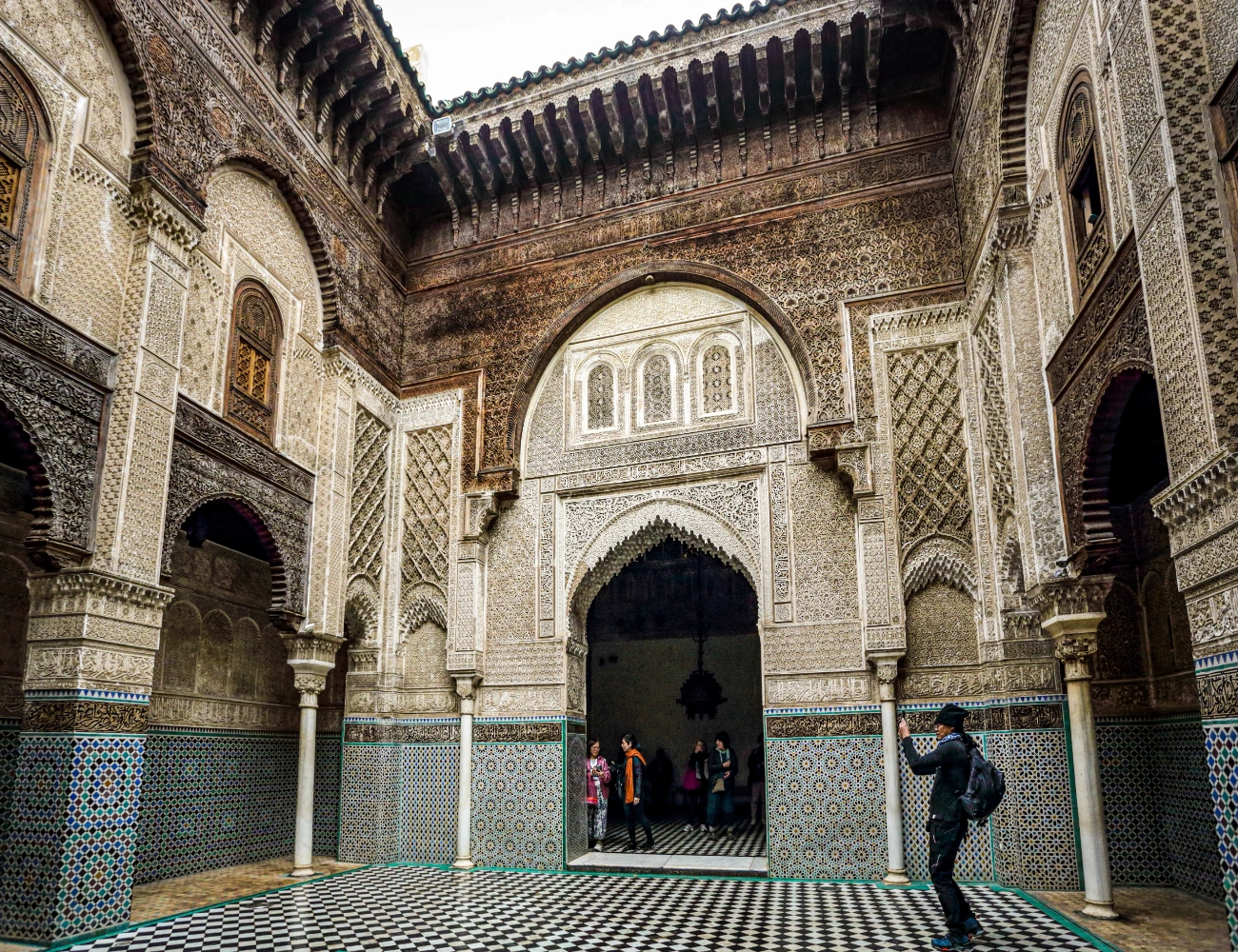
A madrasa (Arabic word for school) served historically as an institution of higher education for law, philosophy, astronomy, and religion. Architecturally, simple student dorm rooms contrast with vast, lavishly decorated central courtyards.

Bou Inania Madrasa in Fes (built 1350–1355 CE).
Bou Inania Madrasa (Fes): Built between 1350–1355 CE by Sultan Abu Inan Faris, this landmark is widely acknowledged as a high point of Marinid architecture. It is the only madrasa in Morocco that also functioned as a full congregational mosque.

Al-Attarine Madrasa in Fes (built 1323–1325 CE).
Al-Attarine Madrasa (Fes): Built between 1323–1325 CE near the famous spice market, Al-Attarine is celebrated for its balanced proportions, intricate plasterwork, and efficient use of space. It has been protected as a national monument since 1915.
Explore Moroccan Architecture with Gate to Morocco
Visiting Morocco offers an immersive journey through living history. Let our experienced local guides show you the hidden details, historic kasbahs, and imperial architectural masterpieces across the country.
