
Fes Travel Guide: Discover the Soul of Morocco’s Ancient City
There are cities you visit, and there are cities you feel. Fes is one of the cities you feel — welcome to our Fes Travel Guide.
The first time you walk toward the old Medina, you may hear the sound of people talking, smell fresh bread and spices, see craftsmen working in tiny shops and suddenly realize that you have stepped into a completely different world.
Then you see it — Bab Bou Jeloud, the famous Blue Gate of Fes. For many travelers, this is where the experience begins.
But the Blue Gate is only the entrance. Beyond it lies Fes el-Bali, one of the world's great historic urban areas, where narrow streets lead to centuries-old mosques, madrasas, workshops, markets and hidden courtyards.
Welcome to Fes
Fes was founded in the late 8th or early 9th century and became an important center of learning, religion, craftsmanship and trade in Morocco.
Its historic Medina, Fes el-Bali, is recognized by UNESCO as a World Heritage site and is known for its remarkably preserved urban fabric, historic buildings and traditional crafts.
But statistics and dates only tell part of the story. To understand Fes, you need to walk through it.
The Medina is full of movement:
- 🍞 A baker pulls bread from an oven.
- 🔨 A craftsman works with metal.
- 🌶️ A shopkeeper arranges colorful spices.
- 🫏 A donkey passes carrying goods.
Somewhere nearby, you hear the call to prayer. This mixture of everyday life and history is what makes Fes so special.
The Blue Gate of Fes — Bab Bou Jeloud
If there is one landmark that almost every visitor associates with Fes, it is Bab Bou Jeloud, better known to travelers as the Blue Gate.
The gate stands at the entrance to the old Medina and has become one of the city's most recognizable symbols. Its beautiful blue-and-green decoration makes it an easy place to stop for photographs, but the real magic begins when you pass through it.
On the other side, the streets become narrower. The modern city starts to disappear. You enter a world of traditional shops, food stalls, craftsmen and historic buildings.
For us, there is something especially appropriate about beginning a Fes journey through a gate.
At Gate to Morocco, we often say that a gate is not just an entrance. It is the beginning of a journey. And Bab Bou Jeloud is exactly that.
Walking Through Fes el-Bali
After passing through the Blue Gate, don't rush. One of the best ways to experience Fes is simply to walk.
The Medina is a maze, and that is part of its charm. You don't always know what is around the next corner. One street may be filled with leather goods. Another may lead to a small bakery. Then suddenly you find yourself standing in front of an ancient madrasa.
The Medina is not a museum. People still live and work here. That is why walking through Fes feels so different from visiting a historical monument where everything is behind glass. The history is still part of everyday life.
Bou Inania Madrasa
One of the most beautiful places to visit near the Blue Gate is the Bou Inania Madrasa. Built during the Marinid period in the 14th century, the madrasa is an extraordinary example of Moroccan architecture.
Take your time here. Look at the details: the carved stucco, the zellij tilework, the cedar wood, and the geometric patterns. Nothing feels accidental.
The architecture reflects the importance of education and religious life in medieval Fes while also showing the extraordinary craftsmanship that Moroccan artisans have developed over generations.
For photographers, it is a dream. For travelers interested in history, it offers a glimpse into the intellectual and religious life of the city. And for anyone who simply appreciates beautiful places, it is worth slowing down and looking carefully.
Al Quaraouiyine — One of the World's Great Centers of Learning
Deep inside the Medina is one of Fes's most famous institutions: Al Quaraouiyine.
Founded in 859 by Fatima al-Fihri, Al Quaraouiyine became an important center of learning in the Islamic world. It is often described as the world's oldest continuously operating university, although the modern concept of a university developed much later, so descriptions of its status can vary depending on the definition being used.
What is not in doubt is its enormous historical importance. For centuries, scholars came to Fes to study religion, law, language, philosophy and other fields of knowledge.
Standing near Al Quaraouiyine gives you a different perspective on Fes. This wasn't simply a city of traders and craftsmen. It was also a city of scholars and knowledge. That intellectual heritage is one of the reasons Fes became such an important cultural center in Morocco.
The Chouara Tanneries
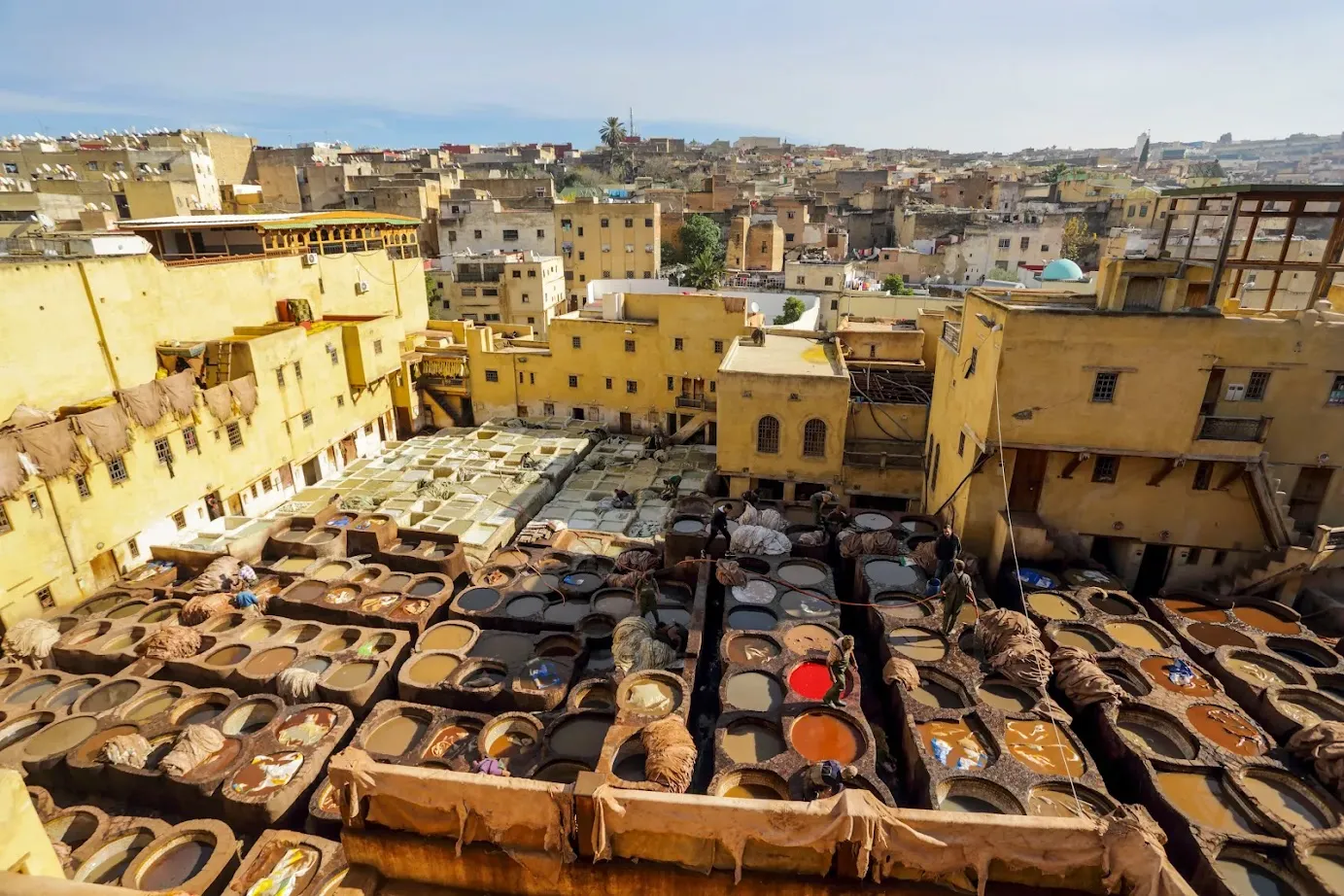
Then there is the place many visitors remember immediately after leaving Fes: the Chouara Tanneries.
From an elevated viewpoint, you can see rows of stone vats filled with different colored dyes. Below, leather workers continue a craft that has been practiced in Fes for centuries.
The smell can be strong — there is no point pretending otherwise — but that is part of the experience. This is not a staged attraction created for tourists. Leather is still being produced and processed here.
Look closely and you'll understand why Fes has such a strong reputation for craftsmanship. Behind every leather bag, belt or pair of slippers is a long process of skilled manual work.
Fes and Moroccan Craftsmanship
Fes is one of the best places in Morocco to appreciate traditional craftsmanship. Walk through the Medina and you will find artisans working with:
✨ Copper
✨ Brass
✨ Wood
✨ Ceramics
✨ Zellij tiles
✨ Textiles
Sometimes you can watch craftsmen working directly in their workshops. You may see a piece being hammered, carved, painted or shaped by hand.
For visitors, these workshops offer something that photographs cannot provide. You can hear the tools, smell the materials, and watch the concentration of the craftsman. You begin to understand that Moroccan handicrafts are not simply souvenirs — for many families, they are part of a living tradition.
What to Eat in Fes
You can't properly experience Fes without eating. Moroccan food is deeply connected to the country's culture, and Fes has its own rich culinary traditions.
While walking through the Medina, you may encounter:
- 🍲 B'stilla: A famous Moroccan pastry traditionally combining delicate pastry with savory and sweet flavors.
- 🍲 Tagine: Slow-cooked dishes prepared with different combinations of meat, vegetables, spices and other ingredients.
- 🥣 Harira: A traditional soup commonly enjoyed across Morocco.
- 🍵 Mint tea: The hospitality drink that seems to appear everywhere.
And then there are the small bakeries and food stalls where you can simply follow your nose. Sometimes the best food experience isn't the restaurant you planned to visit — it is the little place you discover while walking.
Fes Beyond the Medina
Although Fes el-Bali is the heart of the experience, there is more to the city. You can also explore:
👑 The Royal Palace Area
The Royal Palace itself is not open to the public, but its impressive brass gates are worth seeing from outside.
✡️ The Mellah
The historic Jewish quarter provides another perspective on the city's multicultural history.
🕌 Fes el-Jdid
The newer historic section of Fes was developed during the Marinid period and has its own unique character.
🏰 Borj Nord
Offers panoramic views over Fes, helping you understand just how large and dense the historic Medina really is.
How Many Days Do You Need in Fes?
You can see some of the major highlights in one day, but Fes deserves more time if your itinerary allows it.
With one day: You can focus on the Medina, Blue Gate, Bou Inania Madrasa, Al Quaraouiyine area and Chouara Tanneries.
With two days: You can explore at a slower pace and add more neighborhoods, crafts, viewpoints and culinary experiences.
If you're traveling through Morocco for a week or more, Fes works particularly well as part of a larger itinerary connecting the imperial cities with the Sahara Desert.
Fes and the Sahara Desert
One of the most popular journeys from Fes is toward Merzouga and the Sahara Desert. The landscape gradually changes as you leave the city. You travel through the Middle Atlas region, continue toward southeastern Morocco and eventually reach the dunes of Erg Chebbi.
In one trip, you can experience: Ancient Medina ➔ Mountains ➔ Desert
You start among scholars, artisans and historic architecture in Fes and eventually find yourself watching the sunset over golden Sahara dunes. It's a completely different side of Morocco.
Fes to Marrakech via the Sahara
Another popular route is to start in Fes and travel through the Sahara before continuing toward Marrakech. Depending on the itinerary, the journey can include:
Middle Atlas ➔
Ifrane ➔
Cedar Forests ➔
Merzouga (Erg Chebbi) ➔
Todra Gorge ➔
Dades Valley ➔
Ouarzazate ➔
Aït Ben Haddou ➔
High Atlas ➔
Marrakech
This is much more than simply traveling from one city to another. The journey itself becomes part of the experience.
When Is the Best Time to Visit Fes?
Fes can be visited throughout the year. Spring and autumn are often comfortable periods for exploring the city on foot. Summer can be hot, particularly during the middle of the day, so starting early and taking breaks can make sightseeing more comfortable. Winter brings cooler temperatures, especially in the evenings.
Whatever season you choose, comfortable walking shoes are important — you will walk a lot!
A Few Tips for Exploring Fes:
- 👟 Wear Comfortable Shoes: The Medina is made for walking, and some streets are uneven.
- ⏳ Take Your Time: Don't try to see everything in a few hours. Fes rewards travelers who slow down.
- 🗺️ Consider a Local Guide: A local guide can help you understand the history behind the buildings and navigate the Medina easily.
- 🤝 Respect Local Life: Remember that the Medina is a living neighborhood where people live, work and worship.
- ☕ Keep Space in Your Schedule: Don't fill every hour. Leave time to sit, drink mint tea and simply watch the city.
Fes Is More Than a Destination
Perhaps the best way to describe Fes is not with a list of monuments. It is a feeling.
It is the sound of footsteps on an old stone street. The smell of leather near the tanneries. The sound of craftsmen working. The blue entrance of Bab Bou Jeloud. The detailed architecture of Bou Inania Madrasa. The centuries of knowledge connected with Al Quaraouiyine.
And the feeling of walking through a city where history is still part of everyday life. That is Fes.
Discover Fes with Gate to Morocco
At Gate to Morocco, we believe that traveling through Morocco should be more than checking places off a list. We want you to experience the country through its landscapes, history, people and everyday life.
Walk through the Blue Gate. Get lost in the Medina. Listen to the craftsmen. Visit the historic madrasas. Discover the tanneries. Taste Moroccan food. Then continue your journey toward the mountains, the Sahara or Marrakech.
Explore Morocco with Gate to Morocco
Frequently Asked Questions About Fes
What is Fes famous for?
Fes is famous for its historic Medina, traditional craftsmanship, religious and educational heritage, architecture, souks and the Chouara Tanneries.
What is the Blue Gate in Fes?
The Blue Gate is the popular name for Bab Bou Jeloud, a famous entrance to the historic Medina of Fes.
Is the Blue Gate worth visiting?
Yes. It is one of the most recognizable landmarks in Fes and an excellent starting point for exploring the Medina.
What is the Bou Inania Madrasa?
The Bou Inania Madrasa is a historic Marinid-era religious and educational building known for its Moroccan architectural decoration, including zellij, carved stucco and woodwork.
What are the Chouara Tanneries?
The Chouara Tanneries are historic leather-processing facilities in the Fes Medina where traditional leatherworking remains an important craft.
Is Al Quaraouiyine a university?
Al Quaraouiyine is a historic center of Islamic learning founded in 859. It is widely described as one of the world's oldest continuously operating institutions of higher learning, although applying the modern term “university” to medieval institutions depends on the definition used.
How long should I stay in Fes?
One day allows you to see several major highlights, but two days gives you more time to explore the Medina and experience the city without rushing.
Can I combine Fes with the Sahara Desert?
Absolutely. Fes is a popular starting point for journeys toward Merzouga and the Erg Chebbi dunes.
From Fes to the Rest of Morocco
Fes is not simply somewhere to stop on a Morocco itinerary. It is a place to slow down. Walk through the gate. Follow the narrow streets. Listen to the sounds of the Medina. And let the city tell you its story.
Then, when you're ready, continue: From Fes to the Sahara. From Fes to Marrakech. From Fes to the Atlantic coast.
Wherever your journey takes you, Gate to Morocco is here to help you discover it. Your journey starts here.
